
The marketplace is only getting louder, meaning brands must compete harder than ever for attention on the shelf. Whilst price promotions give shoppers an immediate incentive to buy, promotional marketing offers something more: a reason to take part, a chance to win and an experience that can make a brand more memorable.
The truth is, the promotions that consistently convert are the ones built around psychological triggers, giving shoppers another reason to choose one product over another, beyond price alone.
In our work designing promotional campaigns, we see how different mechanics appeal to different motivations, whether that’s the instant result of an instant win, the anticipation of a prize draw or the sense of progress that comes with collect-to-win.
This isn’t about psychological manipulation. It’s about understanding what naturally appeals to shoppers and using that insight to build promotions that work. Here are some of the behavioural triggers we consider when developing gamified promotions.
Instant gratification vs the thrill of the wait
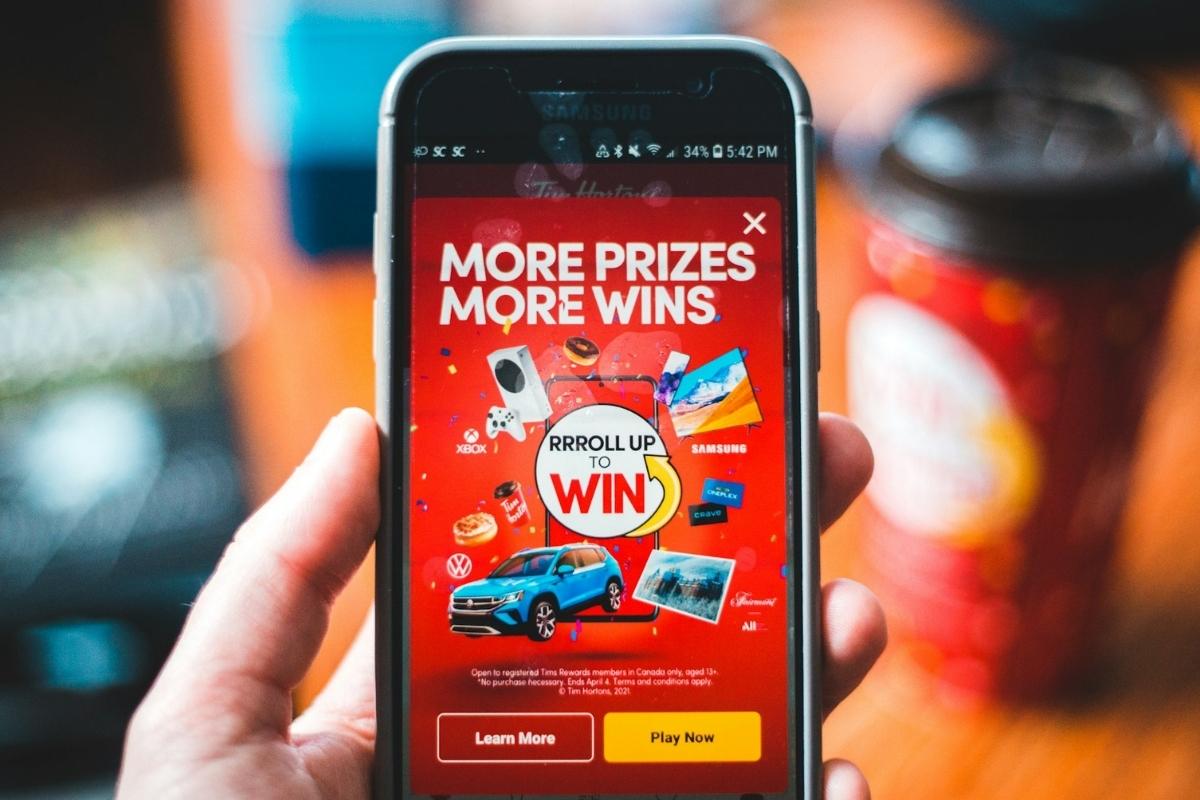
So, what’s the psychology behind an instant win for a shopper? Enter an instant-win promotion, reveal the result and find out whether you’ve won – simple, straightforward and instantly gratifying. The possibility of a reward adds another incentive to buy now, particularly when a shopper is choosing between brands.
There’s also an opportunity to make something of the prize-reveal itself. Those few seconds before the result appears create a small moment of suspense, and a relevant or unexpected reveal can make the experience more memorable. It’s something that was key in our work with Kärcher, where we tied the prize reveal into a brand-relevant experience, making it fun, memorable and relevant to a shopper.
Prize draws work differently – rather than resolving that uncertainty straight away, they allow anticipation to build over time. We typically find this mechanic lends itself better to bigger or more aspirational prizes, where the prospect of winning is part of the attraction.
Neither mechanic is inherently better than the other. Instead, what it comes down to is what makes sense for the brand, the audience, the prize and what the promotion is looking to achieve. What is key to either approach is that the entry method is straightforward. Every additional step creates another opportunity for a potential entrant to drop out, so whether it’s a single text or a simple online entry, making promotion participation easy helps turn initial interest into action.

The appeal of a possible win
Most of us don’t approach a prize draw by calculating the precise probability of winning. We tend to think about what winning would mean to us.
Behavioural economists Daniel Kahneman and Amos Tversky explored this in their work on prospect theory. Their research helps explain why people can give disproportionate weight to small probabilities, particularly when the potential reward is appealing.
And this is where the prize itself becomes important – a draw to win a car and one offering a once-in-a-lifetime holiday may attract people for very different reasons. A car offers a substantial, tangible reward with an obvious practical benefit. A dream holiday invites people to imagine an experience that might otherwise feel out of reach.
What this means in terms of shopper psychology is that the emotional appeal of a prize shouldn’t be underestimated. People aren’t necessarily working out the odds; they’re picturing themselves winning.
There’s also the enjoyment of taking part. A well-chosen prize and an engaging mechanic can turn an otherwise routine purchase into something a little different. And when a promotion feels like a genuine bit of added value, rather than simply another sales tactic, it can leave shoppers with a more positive impression of the brand.
A price cut can be a powerful purchase trigger, but it doesn’t necessarily give shoppers anything to emotionally engage with beyond the saving itself. A promotion offers both an incentive to buy and a moment of enjoyment along the way. And where the mechanic allows multiple entries over a promotional period, there’s an opportunity to keep shoppers engaged beyond a single purchase transaction.
The attraction of “almost there”
We’re often more motivated to finish something when we can see how far we’ve come, and psychologists call this the goal-gradient effect. In its simplest form, this means the closer we get to a goal, the more our motivation to reach it increases.
In a 2006 paper in the Journal of Marketing Research, Ran Kivetz, Oleg Urminsky and Yuhuang Zheng explored this effect through loyalty programmes. In one study, customers given a coffee card with two stamps already added completed the card faster than those given a standard card requiring the same number of purchases. The perceived head start helped motivate them to finish.
The principle has clear applications for collect-to-win promotions – if shoppers can see their progress towards a reward, they have a reason to keep going. A visible stamp collection, a progress bar or a reminder that they’re “only two items away” from completing helps maintain interest and momentum in the promotion.
The psychology here is simple, but useful: when the goal feels achievable, and progress is visible, shoppers have more reason to take the next step.
From psychology to performance
Entry numbers tell you how many people took part, but they don’t tell the whole story. Did the promotion encourage additional purchases? Did it attract new customers, increase repeat purchases or strengthen the relationship with existing shoppers? And did the experience leave people with a more positive impression of the brand? These are the questions worth considering when planning a campaign and deciding what success should look like.
Promotional mechanics can also allow brands to learn more about shopper psychology through participation and, where appropriate, data capture. These are potential benefits that a straightforward price reduction won’t necessarily offer in the same way.
Rather than trying to build every possible behavioural trigger into one campaign, focus on what’s most relevant to your audience and test what works. At Lime, we always start with a clear objective, choose the mechanic that best supports it, and identify what you’d want to learn.
If you’d like to explore how promotional mechanics and shopper psychology could shape your next campaign, get in touch with our team at rosie@wearelime.co.uk or on 02073179280